Platform
Services
Solutions
Resources
Company
Vuln Intelligence
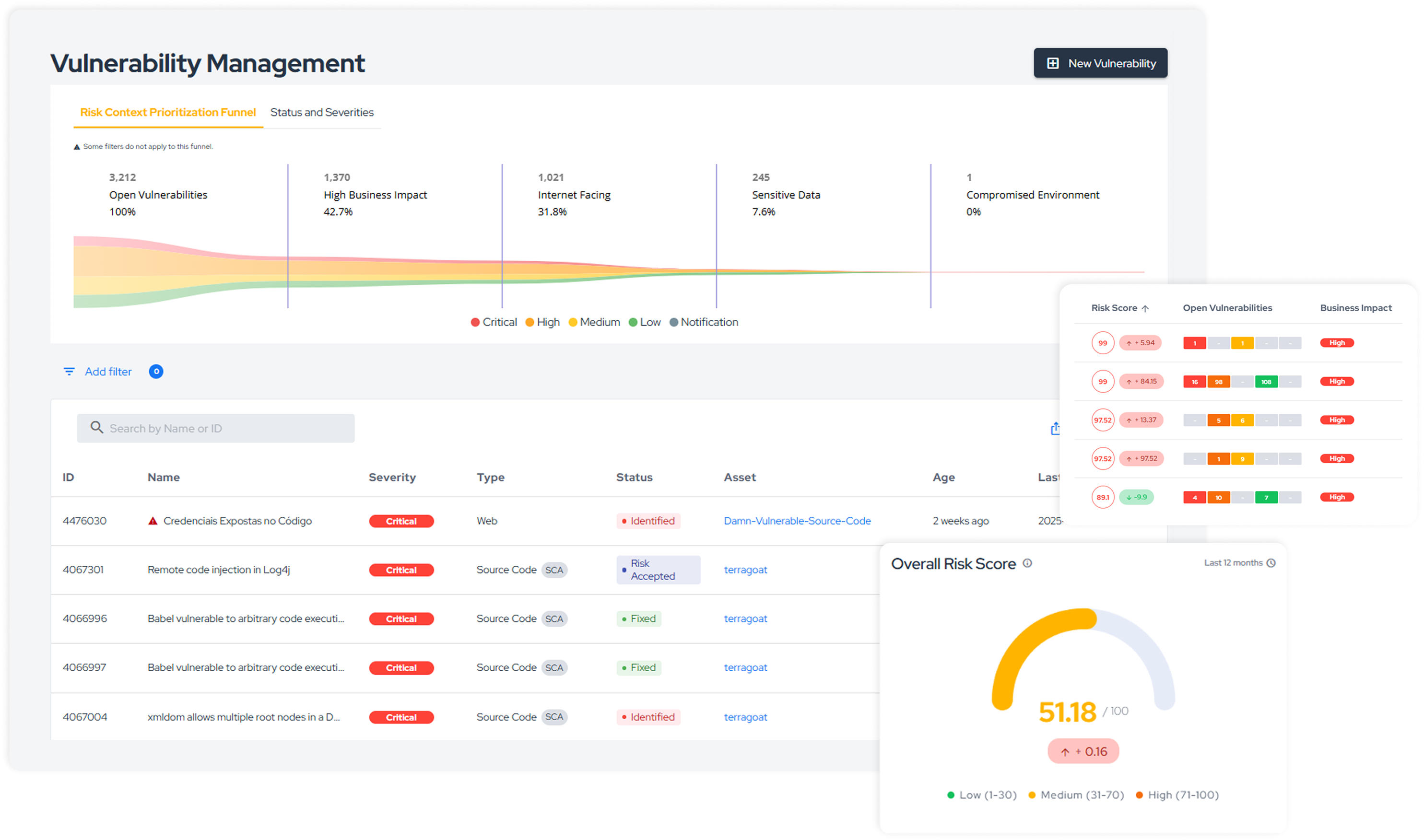
Vuln Intelligence pulls findings from every scanner into one queue, ranked by code origin: the asset each finding comes from and that asset's real risk. Then it opens the ticket, owner and deadline included, in the tool your team already uses.
More scanners, hundreds of findings a week, and a growing share of code written by AI agents. Without a filter for each asset's real risk, the backlog piles up faster than anyone can work through it.
When an alert shows up with false positives, a generic severity, and no suggested fix, developers close the tab. At that point, the tool isn't doing its job.
The scan caught it, but no ticket was opened. Or one was, with no SLA and no owner, and the vulnerability stays exploitable for who knows how long.
Vuln Intelligence runs on the findings you already have. Connect the scanners your team uses today, no rip-and-replace.
SAST, DAST, SCA, pentest, and cloud findings, from Conviso Platform or third-party tools, land in a single queue, correlated and deduplicated automatically.
Priority starts from code origin: the asset the code comes from, that asset's criticality and exposure, and the application context. The queue shows exactly where risk is piling up.
Tickets land in the tool your team already uses, like Jira, Azure DevOps, ServiceNow, Zendesk, or Linear, with priority, SLA, and context attached. Two-way sync keeps status current on both ends.


Conviso Platform connects what your scanners find to what your developers need to fix.
Every finding comes with the asset's risk, its expected impact, and what to do about it, not just a CVE and a generic severity. Noise drops from the very first sprint.
AI sharpens the analysis and filters out false positives before a finding ever becomes a ticket. A few sprints in, developers start paying attention again, because what reaches them is real. On Advanced and Enterprise plans.
Owners and SLAs come from your program's rules, not from whoever spotted the alert first. Nobody has to ask who's on it.
Autofix proposes the patch, and Reachability tells a vulnerable dependency apart from one your code actually reaches. Human sign-off before a fix merges is optional. Your call. On Advanced and Enterprise plans.
MCP Server exposes the backlog to external agents in real time, and Conviso Skills lets them run batch operations like triage, owner assignment, and risk adjustments, with a preview step before anything changes.
No scanner running yet? Start with AI Secure Code. Its findings flow into Vuln Intelligence automatically.
Scanners are running, but priorities are unclear and fixes aren't tracked to the finish. Now there's one risk-ranked queue, traceable from finding to closed ticket.
SAST, DAST, or SCA from different vendors, each with its own console and severity scale. Now every finding is deduplicated and ranked by the same criteria.
Developers get volume and generic severities today, and they've learned to tune them out. Now they only see what's actionable, with the context to fix it.
Priced by asset volume in annual tiers. No surprise bills.
Repositories and CI/CD
Ticketing and chat
Third-party scanners
API and automation
Jira tracks tasks; it doesn't rank security risk. Vuln Intelligence feeds Jira the risk-based priority, the SLA, and the asset context it's missing.
DefectDojo is solid software and an OWASP flagship project, and Semgrep, Trivy, and ZAP are excellent scanners. The real cost is in running it: maintaining the instance, parsers, and integrations, tuning out false positives, and relying on the one or two people who know how it all fits together. Vuln Intelligence gives you consolidation and deduplication with no infrastructure to manage, ranks findings by risk with business context, and comes with a support SLA. You can migrate gradually and keep what already works.
No. Vuln Intelligence takes in findings from tools like Veracode, Checkmarx, Fortify, Snyk, and SonarQube and ranks them by the same criteria.
No. One scanner producing findings is enough. When you're ready for threat modeling and program maturity, Threat & Program Management builds on the same data, no migration needed.
Only if you want it to. On Advanced and Enterprise plans, AI sharpens the analysis, filters out false positives, and proposes fixes with Autofix. Whether a fix needs human approval before it merges is up to your team.
30 minutes with an AppSec specialistBuilt around your organization’s contextNo canned demo